Whether you need a divorce decree for legal proceedings, property settlements, or personal records, understanding how to access Hamilton County divorce records is essential. Divorce records serve as vital legal documents that verify the dissolution of marriage and contain critical information about custody arrangements, financial obligations, and property division. This comprehensive guide walks you through everything you need to know about obtaining, searching, and using divorce records in Hamilton County, Ohio.
From navigating the Clerk of Courts office to understanding the difference between divorce decrees and certificates, we cover all aspects of the records request process. You’ll learn multiple access methods including in-person visits, mail requests, and online searches, along with detailed information about fees, processing times, and required documentation. Whether you’re a former spouse seeking certified copies, an attorney handling legal matters, or a genealogist researching family history, this guide provides step-by-step instructions to help you efficiently locate and obtain the divorce records you need..
Understanding Divorce Records in Hamilton County
Divorce records serve as critical legal documents that verify the dissolution of a marriage and establish important details about property division, custody arrangements, and financial obligations. Hamilton County maintains comprehensive divorce records dating back many decades, providing residents and legal professionals with access to vital information.
What Are Divorce Records?
Divorce records are official court documents that chronicle the legal proceedings and final judgment of a marriage dissolution. These records include essential information such as the names of both parties, case numbers, filing dates, grounds for divorce, and the final decree issued by the court.
In Hamilton County, divorce records typically contain detailed information about asset division, spousal support arrangements, child custody agreements, and any restraining orders or special conditions imposed by the court. These documents are maintained by the Hamilton County Clerk of Courts and become part of the public record, subject to certain privacy restrictions.
The records may include multiple documents such as the petition for dissolution, responses, motions, financial disclosures, separation agreements, and the final judgment entry. Together, these documents create a comprehensive legal record of the divorce proceedings from start to finish.
Difference Between Divorce Decree & Divorce Certificate
Many people confuse divorce decrees with divorce certificates, but these are distinct documents serving different purposes. Understanding the difference is crucial when requesting records from Hamilton County.
A divorce decree is the court’s final order officially ending the marriage. This comprehensive legal document includes detailed information about all aspects of the divorce settlement, including property division, debt allocation, spousal support, child custody arrangements, and visitation schedules. The divorce decree is issued by the Hamilton County Court of Common Pleas, Domestic Relations Division, and serves as the enforceable legal judgment.
A divorce certificate, on the other hand, is a simplified vital record issued by the Ohio Department of Health’s Office of Vital Statistics. This certificate provides basic information confirming that a divorce occurred, including the names of both parties, the date of divorce, and the county where it was granted. Unlike the decree, it does not contain detailed settlement information or court orders.
For most legal purposes such as property transfers, remarriage in certain jurisdictions, or enforcing custody arrangements, you will need the full divorce decree rather than just the certificate. However, for simple verification of marital status, the certificate may suffice.
Why Divorce Records Are Important for Legal & Personal Purposes
Divorce records serve numerous critical functions in both legal proceedings and personal matters. Understanding their importance helps explain why maintaining accurate and accessible records is essential.
For legal purposes, divorce decrees are required to transfer property titles, divide retirement accounts, enforce child support or alimony orders, modify custody arrangements, and prove marital status when remarrying. Attorneys regularly request these documents when representing clients in subsequent legal matters related to the original divorce settlement.
Financial institutions often require divorce decrees when updating beneficiary designations, dividing joint accounts, or processing qualified domestic relations orders (QDROs) for retirement benefits. Government agencies may request these documents when processing Social Security benefits, veteran’s benefits, or immigration applications.
On a personal level, individuals may need divorce records for genealogical research, updating personal records, applying for loans or mortgages, changing legal names back to maiden names, or simply maintaining their own personal files. The comprehensive nature of divorce records makes them invaluable for documenting important life events and legal status changes.
How to Access Divorce Records in Hamilton County
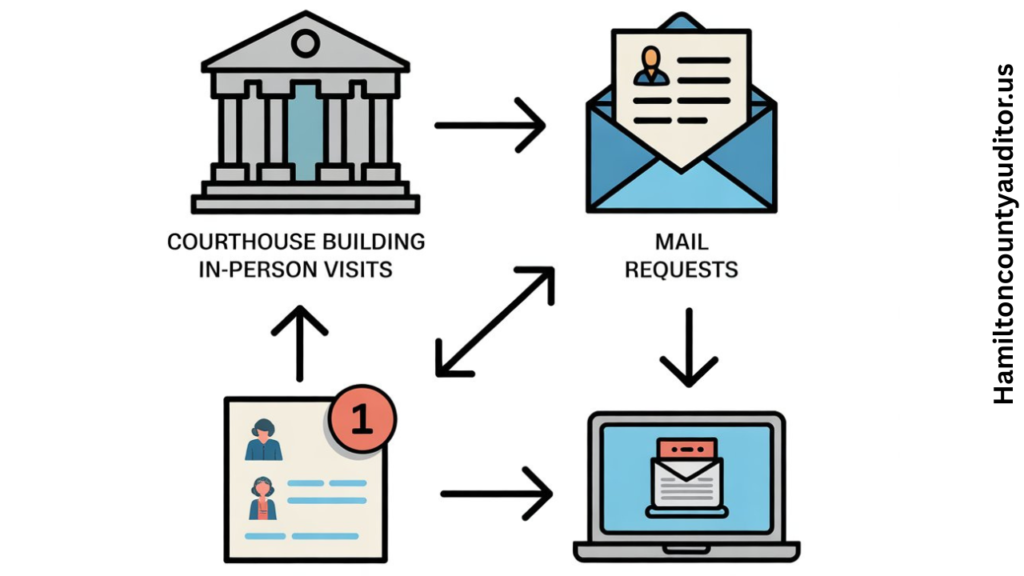
Hamilton County provides multiple convenient methods for accessing divorce records, allowing you to choose the approach that best fits your timeline and preferences. Whether you prefer in-person service, mail requests, or online searches, the Clerk of Courts accommodates various access needs.
Visiting the Clerk of Courts In-Person
The most direct method to obtain divorce records is visiting the Hamilton County Clerk of Courts office in person. The office is located at the Hamilton County Courthouse in downtown Cincinnati, providing walk-in service during regular business hours, typically Monday through Friday from 8:00 AM to 4:00 PM.
When visiting in person, you can search for records using computer terminals available in the public records area or request assistance from clerk staff. You’ll need to provide identifying information such as the names of one or both parties involved in the divorce, approximate date of divorce, or case number if available.
The advantage of in-person visits is immediate access to records and the ability to review documents before ordering copies. Staff members can assist with searches if you’re having difficulty locating specific records. You can obtain certified copies immediately upon payment, making this option ideal when you need documents urgently.
Bring valid photo identification and payment for any copies you need. The clerk’s office accepts cash, checks, money orders, and credit/debit cards. If you’re obtaining records for legal proceedings, be sure to request certified copies rather than standard photocopies.
Requesting Records by Mail or Online
For those unable to visit the courthouse in person, Hamilton County offers mail and online request options that provide convenient alternatives for obtaining divorce records.
Mail Requests: To request records by mail, submit a written request to the Hamilton County Clerk of Courts including the full names of both parties, approximate date of divorce, and case number if known. Include a self-addressed stamped envelope and payment for the requested copies. Processing time for mail requests typically ranges from one to three weeks, depending on the complexity of the search and current office work load Online Access:
Hamilton County provides online access to court records through its public access portal. While you can search and view basic case information online, obtaining certified copies still requires either an in-person visit or mail request. The online system allows you to verify case numbers, review case summaries, and determine what documents are available before submitting a formal request.
The online portal is particularly useful for preliminary research, allowing you to confirm details before requesting copies. However, remember that not all historical records may be available online, especially older divorces that occurred before digital record-keeping systems were implemented.
Comparing Access Methods – Which is Faster & Easier
Choosing the right access method depends on your timeline, location, and specific needs. Each approach offers distinct advantages and potential drawbacks.
In-person visits are fastest, providing same-day access to certified copies. This method works best when you need documents urgently, require assistance navigating the records system, or want to review documents before ordering copies. The main disadvantage is the time and travel required to visit the courthouse during business hours.
Online searches offer the greatest convenience, allowing 24/7 access from any location with internet connectivity. You can research cases, verify information, and prepare for formal requests at your convenience. However, you cannot obtain certified copies online and must ultimately use another method to receive official documents .Mail requests work well for those unable to visit in person and living outside the Cincinnati area. While processing takes longer (one to three weeks), this method requires minimal effort once you submit your request. The trade-off is the extended waiting period and potential for delays if your request lacks sufficient identifying information.
Requesting Certified Copies of Divorce Records
Certified copies carry the official seal and signature of the Clerk of Courts, making them legally valid for court proceedings, property transfers, and other official purposes. Understanding the certification process, eligibility requirements, and associated costs helps ensure you obtain the correct documents efficiently.
Who Can Request a Certified Copy
Ohio law governs who can access certified copies of divorce records, balancing public access with privacy protections for sensitive personal information.
Either party to the divorce can request certified copies of their own divorce decree without restriction. This includes both the petitioner (the person who filed for divorce) and the respondent (the other spouse). Former spouses maintain perpetual access to their divorce records regardless of how much time has passed since the divorce was finalized.
Attorneys representing parties in related legal matters can obtain certified copies by providing proper authorization or demonstrating the relevance to their legal representation. Legal representatives must present appropriate documentation establishing their authority to request records on behalf of their clients.
Third parties may request divorce records since they are generally considered public records in Ohio. However, certain sensitive information within divorce files may be sealed or redacted to protect privacy, particularly information involving minor children, detailed financial data, or sealed settlements. The clerk’s office evaluates each request to determine what information can be released to third parties.
Government agencies with legitimate official purposes can request certified copies by presenting proper credentials and explaining the official need for the records. This includes agencies handling benefit claims, immigration matters, or other administrative proceedings requiring verification of marital status.
Required Identification Documents
To obtain certified copies of divorce records, you must provide proper identification and, in some cases, documentation establishing your relationship to the case or legal authority to request the records.
For in-person requests, bring a valid government-issued photo ID such as a driver’s license, state ID card, passport, or military ID. The identification helps verify your identity and may be required to confirm you are a party to the divorce when requesting your own records.
When requesting records by mail, include a photocopy of your ID with your written request. The copy should be clear and legible, showing your photo, name, and date of birth. Some requesters also include a notarized statement confirming their identity and relationship to the case, though this is not always required.
Attorneys must provide proof of their bar membership and may need to submit documentation demonstrating their representation of a party to the divorce. This might include a letter of representation, court filing showing their involvement in related proceedings, or power of attorney documentation. For genealogical researchers or others seeking historical records, the identification requirements may be less stringent, but you should still be prepared to show valid ID and explain the purpose of your request. The clerk’soffice reserves the right to request additional documentation if questions arise about the legitimacy of the request.
Fees, Processing Time & Delivery Options
Understanding the costs and timelines for obtaining certified divorce records helps you plan accordingly and budget for the necessary documentation.
Fees: Hamilton County charges fees for certified copies based on the number of pages in the document. Typical costs range from to per page, with a minimum fee for certification. A complete divorce decree might cost between 0 and 0 depending on its length and complexity. Additional copies of the same document requested simultaneously often receive reduced per-page rates. Search fees may apply if extensive research is required to locate older records.
Processing Time: In-person requests receive immediate processing, with certified copies available while you wait. Mail requests typically take one to three weeks, though this can extend during busy periods or if the record search proves difficult. Online searches provide instant access to case information, but obtaining certified copies still requires submitting a formal request through in-person or mail channels.
Delivery Options: For in-person requests, you receive certified copies immediately upon payment. Mail requests receive regular postal delivery unless you include payment for expedited shipping. Some requesters include prepaid overnight shipping envelopes to speed return delivery. The clerk’s office does not currently offer electronic delivery of certified copies, as the physical seal and certification are required for legal validity.
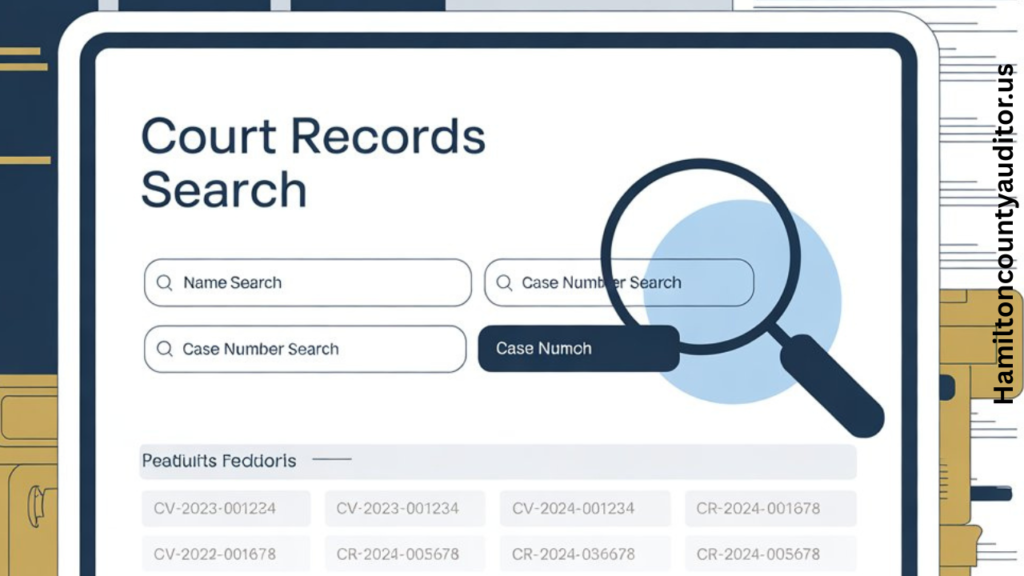
Search Divorce Records by Case Number or Party Name
Hamilton County offers multiple search methods to help you locate specific divorce records efficiently. Whether you have complete case information or only partial details, understanding effective search strategies increases your chances of quickly finding the records you need.
Step-by-Step Name Search in Hamilton County
Searching by party name is the most common method when you don’t have a case number. Follow these steps for effective name-based searches:
Step 1: Access the Hamilton County Clerk of Courts online portal or visit the courthouse to use public access terminals. Navigate to the case search function and select “Domestic Relations” as the case type to narrow your search to divorce cases.
Step 2: Enter the last name of either party to the divorce. The system searches both petitioner and respondent names, so you only need one name to locate most cases. For common surnames, you may need to add the first name or middle initial to narrow results.
Step 3: If you know the approximate year of divorce, use date range filters to limit results. This significantly reduces the number of records to review when searching common names. The system typically allows searches within specific year ranges or date spans.
Step 4: Review the search results to identify the correct case. The results display case numbers, party names, filing dates, and case status. Click on individual cases to view more detailed information including case summaries, filed documents, and disposition information.
Step 5: Once you locate the correct case, note the case number for future reference. You can then request copies of specific documents or the complete file depending on your needs. The case number streamlines any future requests or inquiries about the divorce.
Searching by Case NumberIf you already have the case number from previous documents, court correspondence, or legal paperwork, searching by case number provides the fastest and most accurate method to locate specific divorce records.
Hamilton County case numbers follow a specific format that includes the year and a sequential number. Domestic relations cases typically include a designation such as “DR” in the case number. Enter the complete case number exactly as it appears on your documents, including all letters, numbers, and formatting.
Case number searches immediately retrieve the specific case file, bypassing name searches and common name confusion. You can instantly access the case summary, docket entries, and list of filed documents. This method works especially well when you need to obtain additional documents from a case you’ve previously accessed.
The online portal provides comprehensive case information when searching by case number, including detailed docket entries showing every document filed, all court appearances, and the final disposition. You can often view case summaries and determine exactly which documents you need before requesting certified copies.
Tips for Accurate & Faster Results
Implementing strategic search techniques significantly improves your success rate and reduces time spent searching for divorce records.
Use exact spellings: Verify the correct spelling of names before searching. Small spelling errors can prevent the system from locating records. If you’re unsure of the exact spelling, try variations or use wildcard searches if the system supports them.Consider name changes: Remember that one party may have changed their name during or after the divorce. Search using both married names andmaiden names if applicable. Women who resumed their maiden names after divorce may appear under either name in the records.
Narrow your date range: If you know even the approximate year of divorce, use date filters to reduce results. This proves especially helpful when searching common names that might return hundreds of results without date restrictions.
Try both party names: If searching for one name produces too many results, try searching for the other party’s name. Less common surnames often yield more targeted results.
Check for multiple filings: Some couples may have filed for divorce multiple times before completing the process. Review all related cases to ensure you’re obtaining records from the final, completed divorce.
Contact clerk staff for assistance: If you’re having difficulty locating records despite having reasonable information, clerk staff can provide personalized search assistance. They have access to additional search tools and historical records knowledge that can help locate difficult-to-find cases.
Legal, Property & Family Uses of Divorce Records
Divorce records serve essential functions across numerous legal, financial, and personal contexts. Understanding these various applications helps explain why maintaining accurate, accessible divorce records matters for individuals, families, and legal professionals.
Using Divorce Records for Property & Financial Settlements
Divorce decrees contain detailed provisions governing property division and financial obligations, making them essential documents for executing and enforcing settlement terms.
When transferring real estate ownership following divorce, title companies and county auditors require certified copies of the divorce decree showing how property was divided. The decree serves as legal authority for recording deed transfers, removing names from titles, and establishing sole ownership of previously joint property.
Financial institutions need divorce decrees to process qualified domestic relations orders (QDROs) for dividing retirement accounts, pensions, and 401(k) plans. These orders, which must comply with the divorce decree’s division provisions, allow spouses to receive their awarded share of retirement benefits without tax penalties.
Banks and credit unions require divorce decrees when separating joint accounts, removing co-signers from loans, or establishing individual credit after divorce. The decree’s provisions regarding debt division help determine each party’s responsibility for joint debts and obligations.
Business owners or partners may need divorce decrees to document changes in business ownership percentages, buyout provisions, or the transfer of business interests as part of the settlement. These documents prove essential for updating business registrations, partnership agreements, and ownership records.
Family, Custody & Child Support Matters
Divorce decrees establish the legal framework for ongoing parental responsibilities and children’s welfare, making these documents central to family law matters long after the divorce concludes. Custody provisions in the divorce decree define legal custody (decision-making authority) and physical custody (residential arrangements) for minor children. These provisions form the foundation for parenting time schedules, holidayarrangements, and decision-making responsibilities regarding education, healthcare, and religious upbringing.
Child support orders specified in the decree establish payment amounts, schedules, and termination conditions. The decree serves as the enforcement mechanism when parents seek to collect unpaid support through court contempt proceedings, wage garnishment, or other enforcement methods. County child support agencies rely on these decrees to administer and enforce support obligations.
When parents seek to modify custody or support arrangements, the original divorce decree provides the baseline from which courts evaluate requests for changes. Modification petitions must demonstrate substantial changes in circumstances since the decree was issued, making the original document essential for legal proceedings.
Schools, healthcare providers, and other institutions may request divorce decrees to verify parental rights and responsibilities. The decree clarifies which parent has authority to make educational or medical decisions and provides documentation supporting parental access to records and information.
Genealogy & Historical Research
Beyond their immediate legal applications, divorce records serve as valuable historical documents for genealogical research and understanding family histories.
Genealogists use divorce records to trace family relationships, understand name changes, and document marital status at specific points in time. These records often contain valuable biographical information including birth dates, previous addresses, maiden names, and information about children that might not appear in other public records.Historical researchers studying social trends, family structures, or legal history find divorce records invaluable for understanding changing attitudes toward marriage, divorce grounds and procedures, property rights evolution, and demographic patterns in Hamilton County over time.
Older divorce records provide fascinating insights into historical legal proceedings, societal norms, and family structures from previous eras. Researchers can trace how divorce grounds, settlement patterns, and custody arrangements have evolved over decades or centuries.
For individuals researching their own family history, divorce records often reveal previously unknown family connections, explain gaps in family documentation, or clarify relationships that oral family histories may have obscured or simplified.
Public Access & Privacy of Divorce Records in Ohio
Ohio law generally treats divorce records as public documents, reflecting the principle that court proceedings should be transparent and accessible. However, this public access is balanced against legitimate privacy interests, particularly regarding sensitive personal information and minor children.
Which Divorce Records Are Public in Hamilton County
Most divorce records maintained by the Hamilton County Clerk of Courts are accessible to the public under Ohio’s public records laws. This public access reflects the legal principle that court proceedings are generally open matters of public record.
The basic case information including party names, case numbers, filing dates, and final judgments are publicly searchable and viewable. Anyone can search for divorce cases and access fundamental information about when divorces were filed and finalized.The divorce decree itself, which contains the court’s final orders regarding property division, spousal support, and other settlement terms, is generally a public document. Members of the public can request copies of divorce decrees, though sensitive information may be redacted in some circumstances.
Court pleadings, motions, responses, and other documents filed during divorce proceedings are typically public unless specifically sealed by court order. This includes financial disclosures, property appraisals, and testimony from hearings, all of which become part of the public record once filed with the court.
The public nature of divorce records serves important societal functions, including allowing title companies to verify property ownership changes, enabling background checks for employment or security clearances, and supporting legitimate research into legal and social trends.
Exceptions: Sealed, Juvenile, or Confidential Cases
Despite the general public access to divorce records, Ohio law and court rules provide several exceptions protecting sensitive information and vulnerable parties from unnecessary public disclosure.
Sealed Cases: Courts may seal entire cases or specific documents upon motion by one or both parties showing good cause. Sealed cases remain in the court’s records but are not accessible to the public. Grounds for sealing might include protecting trade secrets, preventing disclosure of sensitive medical information, or safeguarding parties from harassment or harm.
Information About Minors: Documents containing detailed information about minor children receive special privacy protections. While basic custody orders may be public, documents containing children’s addresses, school information, medical records, or other identifying details may be redacted or sealed to protect children’s welfare.Domestic Violence Cases: When divorce cases involve domestic violence protection orders or allegations of abuse, certain information may be sealed to protect victims’ safety. This might include addresses, workplace information, or other details that could enable an abuser to locate a victim.
Settlement Agreements: Some parties negotiate confidential settlement agreements that are not filed publicly with the court. While the basic divorce decree becomes public, detailed settlement terms might remain private if incorporated by reference rather than filed as public documents.
Privacy Measures for Sensitive Records
Hamilton County and Ohio courts implement various measures to balance public access with legitimate privacy interests in divorce proceedings.
Redaction protocols remove sensitive information from public versions of documents while maintaining the substance of court records. Personal identifiers like Social Security numbers, bank account numbers, and children’s dates of birth are routinely redacted from publicly accessible documents.
Parties can file motions requesting that specific documents or information be sealed or kept confidential. The court evaluates these requests based on the sensitive nature of the information and balances privacy interests against the public’s right to access court records. Not all requests are granted; parties must demonstrate compelling reasons for sealing information.
Ohio Supreme Court rules require attorneys and parties to file documents without including unnecessary personal information. These rules encourage protective practices like using initials for children’s names and limiting the inclusion of detailed financial account information in public filings. The clerk’s office trains staff to recognize sensitive information and handle requests for sealed or confidential records appropriately. When members of thepublic request records, staff verify that requesters are not attempting to access properly sealed documents or information protected by court order.
Historical Divorce Records & Archives in Hamilton County
Hamilton County maintains divorce records spanning well over a century, providing valuable historical documentation for researchers, genealogists, and individuals seeking information about past family relationships. Accessing these older records requires understanding different storage methods and availability patterns.
Accessing Old Records via Clerk of Courts
The Hamilton County Clerk of Courts maintains custody of divorce records regardless of age, though the format and accessibility of older records varies significantly from contemporary digital files.
Recent divorce records from approximately the past two to three decades are typically available in digital format, searchable through the online portal or courthouse computer terminals. These electronic records provide the same accessibility as current cases, allowing quick searches and immediate access to case information.
Older divorce records from the pre-digital era exist primarily in paper format, stored in the courthouse archives or off-site storage facilities. Accessing these records often requires more time and assistance from clerk staff who must locate and retrieve physical files from storage.
When requesting historical records, provide as much information as possible including full names of both parties, approximate year of divorce, and any other identifying information. The more details you provide, the easier it becomes for staff to locate records in older filing systems that may not have been indexed as thoroughly as modern digital records.Some very old divorce records may have been transferred to microfilm or microfiche for preservation purposes. Viewing these records requires using special equipment available at the courthouse or through historical research facilities.
Working with Historical Societies & Microfilm
Beyond the Clerk of Courts, several other institutions maintain copies or indexes of historical Hamilton County divorce records, providing alternative access points for researchers and genealogists.
The Cincinnati & Hamilton County Public Library’s Genealogy Department maintains extensive microfilm collections of historical court records including divorce cases. These microfilm records often prove easier to access than the original documents, as library hours and resources may be more convenient for researchers.
Local historical societies sometimes maintain indexes or abstracts of divorce records, particularly for cases of historical significance or involving prominent community members. While these resources don’t replace official court records, they can help researchers identify relevant cases and narrow their searches.
The Ohio History Connection (formerly the Ohio Historical Society) maintains state-level archives that include some Hamilton County court records. Researchers seeking very old records or those with historical research interests might find relevant materials in these state collections.
Online genealogical databases like Ancestry.com and FamilySearch sometimes include indexes or transcriptions of historical Hamilton County divorce records. While these commercial and volunteer-maintained resources don’t replace official records, they provide valuable search tools and may point researchers toward specific cases or time periods worthy of deeper investigation.Timeline & Availability of Historical Records
Understanding the timeline and availability patterns for Hamilton County divorce records helps researchers set realistic expectations and choose appropriate research strategies.
Hamilton County’s official divorce records date back to the early 19th century when the county was established. However, the completeness and organization of records varies significantly across different time periods.
The earliest divorce records from the 1800s may be incomplete, with some records lost to fires, floods, deterioration, or simple record-keeping lapses. Researchers seeking 19th-century records should be prepared for potential gaps and missing documentation.
Records from the early to mid-20th century are generally more complete, though they may exist only in paper format or on microfilm. The 1920s through 1980s period typically offers relatively complete records, though accessing them requires more effort than digital-era files.
Digitization efforts have focused primarily on recent decades, with most records from the 1990s forward available electronically. The clerk’s office continues working to digitize older records, but this remains an ongoing project given the vast volume of historical documents.
Researchers should contact the clerk’s office directly when seeking very old records to inquire about specific availability and access procedures. Staff can advise whether particular time periods have been digitized, are available on microfilm, or require accessing original paper files.
Frequently Asked Questions (FAQ)These frequently asked questions address common concerns about obtaining Hamilton County divorce records.
Frequently Asked Questions (FAQ)
How Do I Get a Certified Copy of My Divorce Decree?
Contact the Hamilton County Clerk of Courts in person, by mail, or online. Provide your full name, former spouse’s name, approximate divorce date, and valid ID. Fees range from 0-0 depending on document length. In-person requests receive same-day service; mail requests take 1-3 weeks.
Can I Access Divorce Records Online for Free?
Yes, you can search basic case information online for free through the Hamilton County Clerk of Courts portal. However, obtaining certified copies requires a formal request and payment of applicable fees. The online system helps verify case details before requesting official documents.
How Far Back Do Hamilton County Divorce Records Go?
Hamilton County divorce records date back to the early 19th century. Older records may be incomplete due to fires or deterioration. Records from the 1990s forward are typically digital. For historical records, contact the Clerk of Courts to inquire about specific time period availability.
Are Certified Copies Available by Mail or Online?
Certified copies are available by mail but not online. Submit a written request with both parties’ names, divorce date, case number (if known), payment, and self-addressed envelope. Processing takes 1-3 weeks. Electronic delivery is not available as the physical seal is required for legal validity.
Conclusion
Accessing Hamilton County divorce records is straightforward when you understand the available methods, requirements, and uses for these important legal documents. Whether you need records for property transfers, child custody matters, genealogical research, or other purposes, the Hamilton County Clerk of Courts provides multiple access options to meet different needs and timelines.
By following the guidance in this article, you can efficiently locate and obtain the divorce records you need through in-person visits, mail requests, or online searches. Understanding the differences between document types, knowing eligibility requirements, and preparing proper identification ensures a smooth process.
Remember that divorce records serve essential functions long after finalization, supporting legal compliance, protecting rights, and documenting important life events. Keeping certified copies in a safe place protects you from future delays when these documents are needed for time-sensitive matters.