Searching for marriage records in Hamilton County, Ohio? Whether you need a certified copy for legal purposes, want to verify marital status, or are tracing your family history, understanding how to access Hamilton County marriage records is essential. These vital documents serve multiple purposes from name changes and property transfers to genealogical research and court proceedings. Hamilton County Probate Court maintains an extensive database of marriage licenses and certificates dating back decades, making it a valuable resource for residents and researchers alike.
This comprehensive guide walks you through everything you need to know: how to search records by name or license number, request certified copies, understand the difference between licenses and certificates, and navigate public access regulations. Whether you’re applying for government benefits, settling an estate, or building your family tree, you’ll find step-by-step instructions, fees, processing times, and expert tips to make your search quick and successful.

Understanding Hamilton County Marriage Records
Marriage records are official government documents that prove a legal union between two individuals. In Hamilton County, Ohio, the Probate Court serves as the official custodian of all marriage-related documentation. These records include marriage license applications, marriage certificates, and supporting affidavits. Understanding the nature and purpose of these documents helps you determine which record type you need for your specific situation.
Marriage records contain vital information such as full names of both parties, date and place of marriage, names of witnesses, officiant details, and sometimes parental information. These documents are considered vital records under Ohio law, meaning they’re maintained permanently and serve as legal proof of marital status. Whether you’re establishing legal rights, conducting background checks, or researching family lineage, Hamilton County marriage records provide authenticated documentation that’s recognized by government agencies, financial institutions, and courts nationwide.
What Are Marriage Records?
Marriage records are official vital documents maintained by Hamilton County Probate Court that legally document marriages performed within the county. These records include the marriage license (permission to marry), marriage certificate (proof of ceremony), and related documentation containing personal details, ceremony information, and legal attestations that establish marital status.
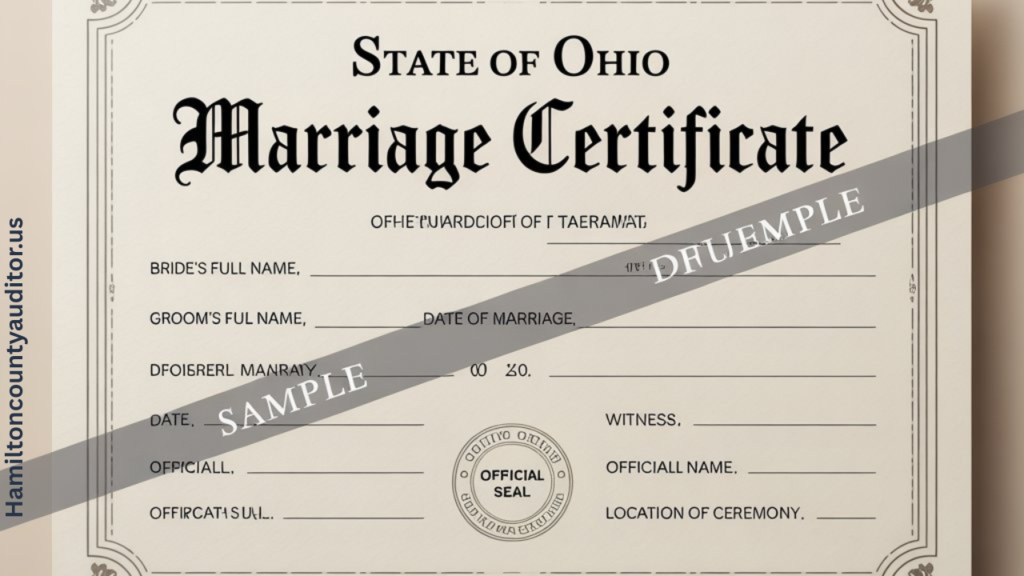
Difference Between Marriage License & Marriage Certificate
A marriage license is permission to marry, obtained before the ceremony and valid for 60 days in Ohio. A marriage certificate is issued after the ceremony, serving as legal proof that the marriage occurred. The certificate contains officiant signatures and is the document needed for name changes, benefits, and legal matters.
Legal and Personal Uses of Marriage Records
Marriage records serve numerous purposes: name change documentation, spousal benefits claims, health insurance enrollment, immigration applications, property ownership transfers, tax filing status verification, estate settlements, inheritance claims, divorce proceedings, adoption processes, genealogical research, historical documentation, and legal verification in court cases requiring proof of marital status.
How to Access Marriage Records in Hamilton County
Hamilton County offers multiple convenient methods to access marriage records, each suited to different needs and timeframes. The Probate Court, located in downtown Cincinnati, provides in-person services, mail requests, and limited online search capabilities. Choosing the right access method depends on factors like urgency, whether you need certified copies, the record’s age, and your location.
In-person visits offer immediate access to recent records and the ability to consult with court staff for assistance. Mail requests work well for those outside the area or seeking historical records. Online searches provide quick verification of record existence but may not offer certified copies directly. Understanding the advantages and limitations of each method ensures you choose the most efficient approach for your specific situation, saving time and avoiding unnecessary trips or delays.
Visiting the Probate Court In-Person
Visit Hamilton County Probate Court at 230 East Ninth Street, Cincinnati, OH 45202 during business hours (typically 8:00 AM – 4:00 PM weekdays). Bring valid photo identification and payment for copy fees. Staff can search records, provide certified copies immediately for recent marriages, and assist with historical record searches requiring additional time.
Requesting Records by Mail or Online
Mail requests should include the couple’s full names, marriage date (or approximate date), reason for request, requester’s contact information, government-issued ID copy, and appropriate fees (check or money order). Online searches through the court’s website allow basic verification but certified copies typically require mail or in-person requests with proper documentation.
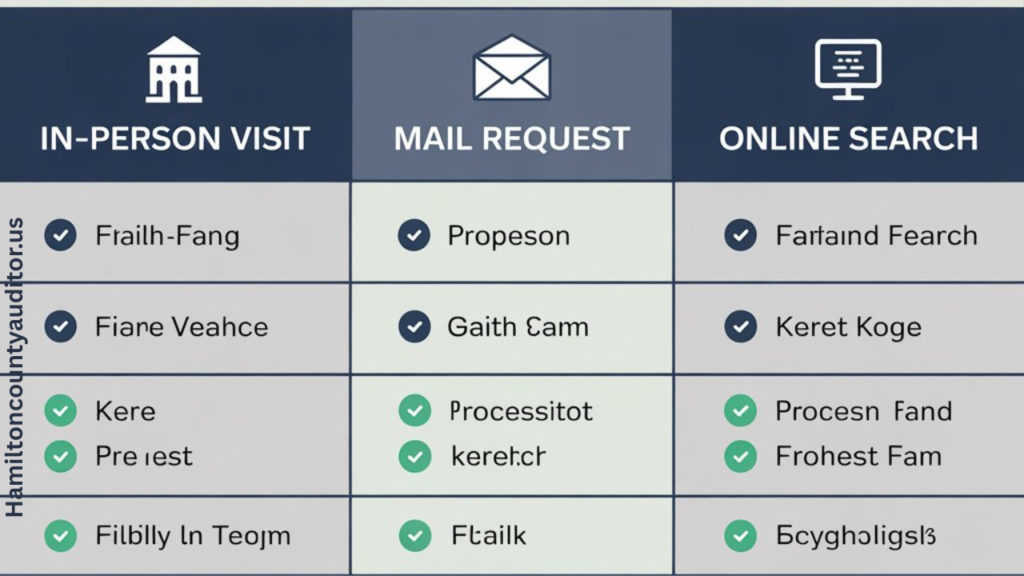
Comparison of Different Access Methods
In-person visits offer same-day service for recent records but require travel. Mail requests take 2-4 weeks but work from anywhere. Online searches provide quick verification at no cost but don’t provide certified copies. Choose based on urgency, location, certification needs, and record age for optimal results.
Requesting Certified Copies of Marriage Records
Certified copies are official documents bearing the court’s raised seal and authorized signature, making them legally valid for official purposes. Unlike informational copies or online printouts, certified copies are required for name changes with Social Security Administration, passport applications, immigration petitions, property transfers, insurance claims, and court proceedings.
Hamilton County Probate Court issues certified copies only to authorized individuals who demonstrate legitimate interest. The certification process ensures document authenticity and prevents fraud. Each certified copy includes security features like watermarks, embossed seals, and unique certificate numbers. Processing times vary based on request method and record age—recent marriages may receive same-day service, while historical records require archival searches. Understanding who can request copies, what documentation you’ll need, associated fees, and expected timeframes helps you plan accordingly and avoid delays in time-sensitive situations.
Who Can Request a Certified Copy
Parties named on the marriage record, parents of parties, legal representatives with power of attorney, attorneys representing either party, individuals with court orders, and persons demonstrating direct tangible interest (like heirs in estate matters) can request certified copies. Casual inquirers and unrelated third parties cannot obtain certified copies.
Required Documents & Identification
Submit a completed application form with full names of both parties, exact or approximate marriage date, requester’s relationship to parties, purpose of request, and current contact information. Include government-issued photo ID (driver’s license, passport, or state ID), proof of relationship if applicable, and appropriate payment (cash, check, money order).
Fees, Processing Time & Delivery
Hamilton County charges approximately $3-$5 for the first certified copy and $2 for additional copies requested simultaneously (verify current fees with the court). In-person requests for recent records process same-day. Mail requests take 2-4 weeks. Expedited services may be available for additional fees in urgent situations.
Search Marriage Records by Name or License Number
Effective searching requires accurate information and understanding of Hamilton County’s indexing system. Marriage records are indexed by both parties’ surnames and license numbers, allowing multiple search approaches. The more information you provide full legal names, approximate marriage dates, middle names, or license numbers the faster and more accurate your search results will be.
Hamilton County’s marriage database contains records spanning over a century, with computerized indexes for recent decades and manual card files or microfilm for historical records. Name variations, spelling errors, and cultural naming conventions can complicate searches. For example, hyphenated names, nicknames, or name changes from previous marriages might require multiple search attempts. License numbers provide direct access when available, eliminating ambiguity from common names. Court staff can assist with difficult searches, especially for records predating digital indexes or involving unusual circumstances.
Step-by-Step Name Search in Hamilton County
Begin with both parties’ full legal names and approximate marriage date. Contact Probate Court by phone, mail, or in-person. Provide complete spelling of surnames and first names. If initial search fails, try name variations, different time ranges, or provide additional details like parents’ names or ceremony location.
Searching Using Marriage License Number
License numbers provide the most direct search method. This unique identifier appears on marriage licenses, certificates, and related documents. Contact the Probate Court with the complete license number for immediate record location. This method eliminates confusion from common names and speeds processing significantly, especially for recent marriages.
Tips for Faster and Accurate Results
Use full legal names (not nicknames), provide exact or narrow date ranges, specify both surnames, note any name changes from previous marriages, check spelling carefully, mention the ceremony location if known, bring supporting documents if available, search during less busy times, and consider hiring professional genealogists for complex historical searches.
Legal and Historical Importance of Marriage Records
Marriage records serve as foundational legal documents with far-reaching implications across civil law, property rights, taxation, and family relationships. Courts, government agencies, financial institutions, and historians rely on these records for establishing rights, verifying relationships, and documenting social patterns. The legal weight of certified marriage records makes them indispensable in countless situations.
Beyond immediate legal applications, marriage records preserve social history and demographic patterns. Researchers study marriage trends, age patterns, migration movements, and cultural practices through these documents. Genealogists reconstruct family trees spanning generations. Historians analyze social changes reflected in marriage patterns. Economists study household formation. The dual nature of marriage records as both legal instruments and historical artifacts ensures their permanent preservation and careful maintenance by Hamilton County authorities, making them valuable resources for current legal needs and future historical understanding.
Using Records for Property, Taxes & Inheritance
Marriage records establish spousal rights to jointly-owned property, determine tax filing status, prove eligibility for marital deductions, establish inheritance rights in estates without wills, verify beneficiary relationships for life insurance and retirement accounts, support claims in property disputes, and provide evidence in probate proceedings and asset division matters.
Genealogy & Family History Research
Genealogists use marriage records to connect generations, identify maiden names, locate family members, determine birth locations through parental information, establish timelines, verify relationships, find witnesses who might be relatives, cross-reference with other vital records, build comprehensive family trees, and uncover previously unknown family connections across multiple generations.
Marriage Records in Court & Legal Proceedings
Courts accept certified marriage records as evidence in divorce proceedings, custody cases, name change petitions, immigration hearings, fraud investigations, bigamy cases, estate disputes, insurance claims, Social Security hearings, veterans’ benefit appeals, wrongful death lawsuits, and any legal matter requiring proof of marital status or relationship verification.
Public Access & Privacy of Marriage Records in Ohio
Ohio law generally treats marriage records as public documents, balancing transparency with privacy concerns. The public nature of marriage records reflects their historical role in preventing bigamy, ensuring legal marriages, and maintaining accurate civil records. However, not all marriage-related documents are equally accessible, and certain circumstances warrant confidentiality protections.
Hamilton County Probate Court follows Ohio Revised Code provisions governing vital records access. While basic marriage information is publicly searchable, certified copies are restricted to authorized individuals with legitimate interests. This two-tiered system allows public verification of marital status while protecting against identity theft and unauthorized use of personal information. Understanding which portions of marriage records are public, who can access different document types, and what protections exist for sensitive situations helps requesters navigate privacy regulations while exercising their legal rights to information.
What Records Are Public in Hamilton County
Basic marriage information—names of parties, marriage date, and license issuance—is publicly accessible and searchable. Anyone can verify whether a marriage occurred. However, detailed records containing Social Security numbers, signatures, addresses, and other sensitive personal information are restricted to authorized parties with demonstrated legitimate interest or legal authority.
Exceptions: Sealed or Confidential Records
Courts may seal marriage records in cases involving witness protection, domestic violence victims, identity theft concerns, ongoing criminal investigations, or court orders protecting vulnerable parties. Confidential marriage licenses (available in some states but not Ohio) don’t apply in Hamilton County. Sealed records require court orders for access.
Protecting Privacy for Sensitive Records
Hamilton County implements security measures including identity verification for certified copy requests, restricted access to Social Security numbers and birthdates, secure document storage, trained staff awareness of privacy regulations, redaction of sensitive information in public indexes, and compliance with both state privacy laws and federal regulations protecting personal information.
Historical Marriage Records & Archives
Hamilton County’s marriage records extend back to the county’s formation in 1790, creating an invaluable historical archive spanning over two centuries. These historical records document social changes, migration patterns, demographic shifts, and individual family histories across generations. Accessing older records requires understanding their format, location, and preservation status.
Historical records face unique challenges: handwritten entries, faded ink, deteriorating paper, varying indexing systems, and storage on microfilm or microfiche. The transition from handwritten ledgers to typed records to computerized databases created different access points for different eras. Records from the 1700s-1800s may exist only on microfilm at historical societies or state archives. The Probate Court maintains the most recent decades directly, while older materials require specialized research skills. Genealogists and historians benefit from understanding both court holdings and supplementary archives, as well as the technological and format transitions that occurred over Hamilton County’s long record-keeping history.
Accessing Old Records via Probate Court
Hamilton County Probate Court maintains direct access to marriage records from recent decades in computerized databases. Older records from mid-1900s backward exist on microfilm or microfiche. Very old records may require archival searches, extended processing time, and staff assistance due to handwriting challenges, index gaps, and preservation concerns.
Working with Historical Societies & Microfilm
The Cincinnati & Hamilton County Public Library, Ohio History Connection, and local historical societies maintain microfilmed marriage records. These repositories offer research rooms with microfilm readers, digital scanning capabilities, and knowledgeable staff. Some records are digitized and searchable online through genealogy websites like FamilySearch and Ancestry.
Timeline of Record Availability
Hamilton County marriage records begin in 1790s with sparse early documentation. Systematic record-keeping improved by mid-1800s. Indexes become more complete by early 1900s. Typewritten records replace handwritten entries around mid-1900s. Computerized databases begin 1970s-1980s. Recent decades offer online searchability with immediate access, while historical records require research assistance.
Conclusion
Hamilton County marriage records serve as vital legal documents and invaluable historical resources, providing authenticated proof of marriages dating back over two centuries. Whether you need a certified copy for name changes, immigration applications, property transfers, or inheritance matters, understanding the request process ensures smooth and efficient access. The Probate Court offers multiple access methods—in-person visits for immediate service, mail requests for remote applicants, and online searches for quick verification—each suited to different needs and circumstances.
Remember to bring proper identification, provide accurate information about both parties and marriage dates, and allow adequate processing time, especially for historical records. Certified copies cost approximately $3-$5, with same-day availability for recent marriages and extended timeframes for archival searches. For genealogical research, combine Probate Court resources with historical societies and online databases. By following the step-by-step guidance in this comprehensive guide, you’ll navigate Hamilton County’s marriage record system confidently, obtaining the documentation you need for legal matters, family research, or historical inquiry with minimal delays and maximum accuracy.
FAQS.
How Do I Get a Certified Marriage Certificate?
Contact Hamilton County Probate Court in-person at 230 East Ninth Street, Cincinnati, by mail, or phone. Complete the application with both parties’ names and marriage date. Provide government-issued ID and payment. Certified copies typically cost $3-$5. In-person requests for recent marriages process same-day; mail requests take 2-4 weeks.
Can I Access Marriage Records Online for Free?
Hamilton County Probate Court’s website offers basic marriage record searches for verification purposes at no cost, showing whether a marriage exists. However, certified copies required for legal purposes cannot be obtained free online—they require formal application, identification verification, and payment of fees through mail or in-person requests.
How Far Back Do Hamilton County Marriage Records Go?
Hamilton County marriage records begin from the county’s establishment in 1790. Early records are sparse with gaps and varying completeness. Systematic record-keeping improved significantly by the mid-1800s. Complete, well-indexed records are available from the late 1800s forward, with recent decades fully computerized and easily searchable.
Are Certified Copies Available by Mail?
Yes, certified copies are available by mail. Submit a completed application form, copies of government-issued identification, specific information about the marriage (names, date), reason for request, and payment via check or money order to Hamilton County Probate Court. Processing takes approximately 2-4 weeks with delivery via USPS.